Why the APBT Is Foundational to Legionarius

There are many reasons to build on American Pit Bull Terrier blood, but for us one stands above the rest: gameness.
That word gets misunderstood, softened, and sometimes avoided altogether. We are not interested in softening it. Gameness is the drive to continue the fight regardless of pain, pressure, fatigue, or the size and power of the opponent. It is the refusal to quit when quitting would be easier. It is not flash, noise, bluff, or theatrical aggression. It is not instability. It is not panic. It is resolve.
And resolve matters.
At Legionarius, we are not trying to produce unstable animals or chaotic household liabilities. We are building strong, capable family companions with real-world usefulness. The dog must be safe with its people. It must be clear-headed around family and friends. It must live as a companion first. But if real danger ever arrives, the dog must have the kind of inner substance that does not evaporate under pressure. Most people will never face a truly determined attacker, but such opponents do exist. Anyone who has spent time around war, violent crime, law enforcement, or hard urban reality knows that some threats do not fold the moment resistance appears. Against that kind of danger, surface-level intensity is not enough. Athleticism is not enough. Size is not enough. We need a dog that will stay in the fight.
That is where the American Pit Bull Terrier separates itself from nearly every other breed on earth.
Other breeds can be courageous. Other breeds can be hard. Other breeds can show flashes of deep determination. But the APBT has long stood apart for how often it produces dogs with this quality and how deeply that quality can run. This is why the breed matters so much to us. Not because of trend, image, or mythology, but because there is something in the blood that generations of selection burned in with rare consistency. A properly bred APBT carries a kind of commitment that cannot be faked and cannot be manufactured at the last minute. When pressure comes, the dog reveals what it is. With the APBT, the answer has too often been the same to ignore: it does not quit.
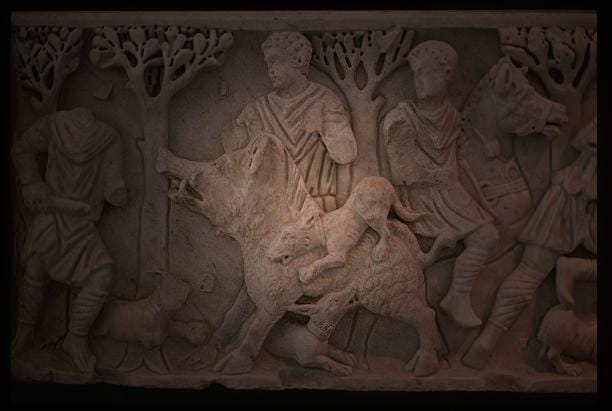
That kind of trait does not appear overnight. It comes from long inheritance, from old selection, from ancient demands placed on canine bodies and minds. The exact origins are hard to map with perfect certainty because these dogs reach far back into history. Records are incomplete, but the type is old. Very old. There is artwork from the Roman Empire that shows boar-hunting dogs so similar to ours they could compete in a modern APBT conformation show. There are old stories of powerful men and empires testing dogs for courage and tenacity against terrible odds. One famous tradition holds that Alexander the Great prized the dog that would not quit, even when matched against the overwhelming force of a lion or elephant. Whether every detail of every old story can be proven is almost beside the point. The ideal is ancient, and the blood still speaks. Across centuries, the highest ideal of the canine warrior was never mere size or fury. It was the will to continue.
That is the inheritance we respect.
Just as important, deep gameness often travels with something else that modern dog culture badly needs: confidence. A truly secure dog is not a nervous wreck. It is not a fear-biter. It is not a creature living on the edge of panic, snapping because it cannot process stress. The dog we want is self-possessed. It does not need to posture. It does not need to prove itself every minute. It is not constantly looking for reasons to erupt. It carries itself with quiet certainty. There is something almost heroic in that kind of temperament. Think of the old warrior ideal, not a hysterical beast, but a calm and grounded fighter who is slow to anger and absolute in commitment once the fight is real.
That is closer to our vision of Legionarius.
We want a dog that can be your best friend and your child’s trusted companion, yet still possess the seriousness to meet genuine danger without hesitation. We want a dog that is social when social behavior is correct, stable when stability is required, and forceful only when force is necessary. We do not want indiscriminate aggression. We do not want unstable nerve. We do not want a liability that confuses tension with threat. The goal is not chaos. The goal is reliability under pressure. When the chips are down, behavior must still be correct.
This is one of the great strengths of the APBT foundation. At its best, the breed combines athletic ability, pain tolerance, mental commitment, and a kind of honest temperament that is too rare in modern dogs. It can be affectionate without being soft. It can be driven without being frantic. It can be powerful without being clumsy. It can be serious without becoming nervy. Those are exactly the ingredients that matter if you are trying to create a companion with executive protection potential, real working utility, and the kind of steady household presence people can actually live with.
For us, gameness is not an antique curiosity. It is not a romantic word dragged out to sound hard. It is a living trait with real value when properly understood and properly placed. In a world full of unstable dogs, cosmetic breeding, shallow nerves, and even performance without substance, gameness still means something. It means depth. It means honesty. It means the dog is still there when hardship strips everything else away.
That is why the APBT holds such a foundational role in our program.
We are building Legionarius on more than looks and more than hype. We are building on character. We are building on clear-headed companionship, functional athleticism, and serious resolve. We are building on a dog that can live close to the family, read the room correctly, and remain trustworthy until the moment trust must become action. And when that moment comes, we believe the foundation should be a breed that has proven, generation after generation, that quitting is simply not part of its nature.
That is the promise in the blood. That is the standard we respect. And that is why we start here.